
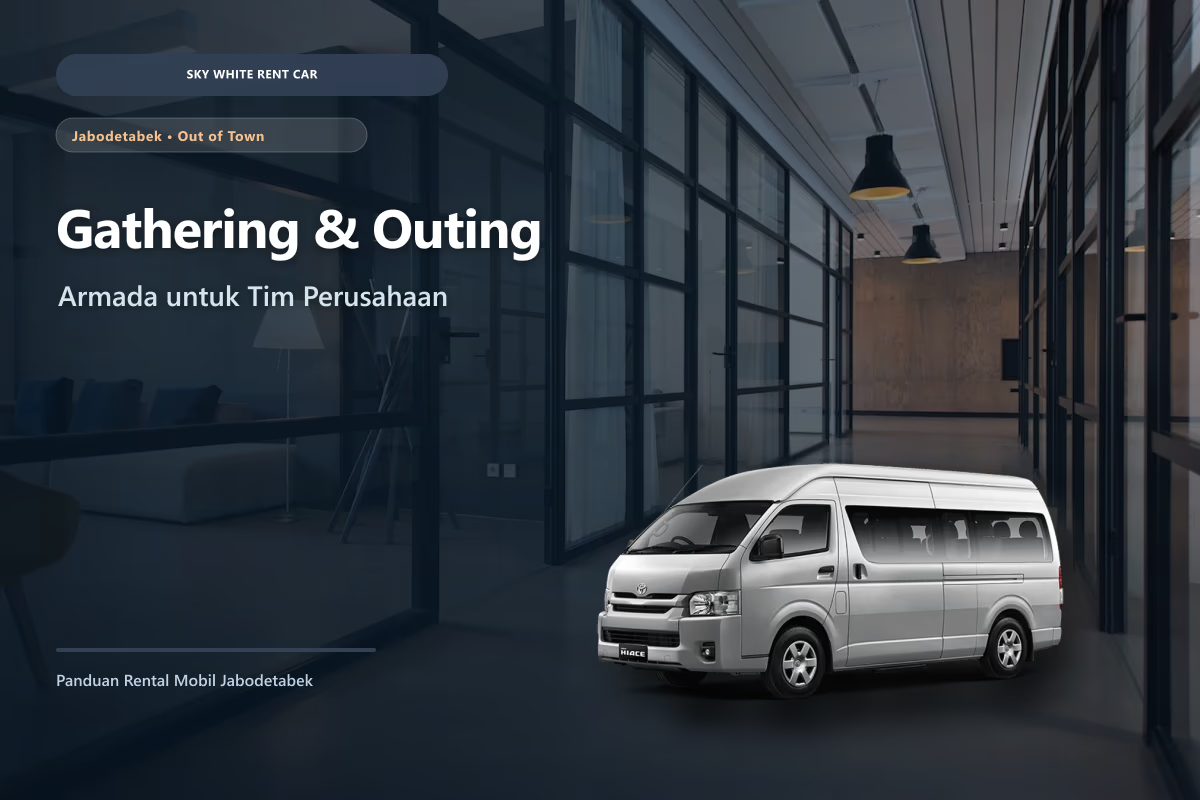
Company gatherings fail when mobility fails
Corporate outings and gatherings are usually built around tight rundowns: morning registration, ice-breaking, outdoor sessions, lunch, then closing. One late bus or delayed cluster can shift the entire agenda. In Greater Jakarta, variables multiply: cross-city congestion, narrow venue access, limited parking, and employees arriving from many locations.
That is why car rental for gatherings should not be treated like a casual daily hire. You are managing clusters, capacity, PIC communication, and admin documents (invoice or PO) as one system. When that framework is clear early, HR and GA stay calmer, participants are more comfortable, and venue vendors do not reshuffle because a group arrives late.
This guide is for teams planning Q3 outings, team building, or office gatherings around Jakarta and its satellites. Start from the event and gathering transport page for Hiace, Elf, and multi-pickup schemes, compare shuttle options, then match with-driver or driver models with the corporate framework.
Map the event pattern first: single point vs multi-point
Before booking units, write the mobility pattern on one page. That pattern decides whether you need Hiace, multi-unit MPVs, or a shuttle-plus-VIP mix.
| Event pattern | Example scenario | Typical fleet | Coordination focus |
|---|---|---|---|
| Single pickup point | Everyone gathers at the office, then to venue | Hiace / multi Hiace | On-time departure discipline |
| Multi pickup points | Clusters from stations, apartments, and office | Shuttle + MPV | Per-cluster PIC and ETA |
| Distant venue + VIP | General participants + separate directors | Hiace + Innova/SUV | VIP schedule priority |
| 2D1N outing | Day-1 transfer, day-2 local, return day 2/3 | Multi-day multi-unit | Overtime and return timing |
| Hybrid | Some employee self-drive, some rental | Backup units + shuttle | Parking and drop-off points |
If the pattern is unclear, do not rush to lock unit counts. Miscounting clusters usually costs more than adding one unit early: overtime, venue delay, and repeated day-of messaging.
Multi-unit booking: when one Hiace is not enough
One Hiace looks efficient on paper. In the field, “full” capacity is often uncomfortable when participants bring laptop bags, door-prize boxes, or outdoor gear. Multi-unit planning helps when:
- Headcount exceeds one comfortable cluster (not just “seats available”).
- Pickup points span more than two locations.
- You need VIP / committee / general participant separation.
- The venue drop-off limit cannot handle a long queue.
- You want a spare unit for delay or breakdown risk.
| Estimated participants | Fleet approach | Practical note |
|---|---|---|
| 8-12 | 1 Hiace or 2 MPVs | Check real luggage space, not seats alone |
| 13-20 | 2 Hiace or Hiace + MPV | Separate committee if the rundown is tight |
| 21-35 | 2-3 Hiace | Require per-unit PIC in radio/WA groups |
| 36+ | Multi Hiace + VIP unit | Stagger departure waves by 5-10 minutes |
Compare categories on the rental page, then align with corporate policy so documents and SLAs are clear before outing day.
Hiace for gatherings: strengths and limits
A Hiace (or equivalent class) is strong when you want the group to stay together. Coordination is simpler: one point, one chauffeur, one clock. Limits that are often ignored:
- Access roads to villas or outbound camps can be narrow.
- Turning space at venues may be limited.
- Full seats reduce room for bags and snack boxes.
- One late passenger can hold the entire cabin.
Mitigation: set a boarding cut-off (for example 10 minutes before departure), prepare a name manifest per unit, and appoint a PIC who can decide “leave now” versus “wait.”
Shuttle: recurring patterns that stay cleaner
When a gathering uses repeating transfer patterns (station to venue, or hotel to activity site), shuttle service is usually cleaner than ad-hoc booking. Shuttle fits when:
- Schedules are fixed (morning out, evening return).
- Participant volume is relatively stable per wave.
- Pickup points are familiar to chauffeurs.
- The company wants more structured cost and documentation.
For one-off outings with many variables, a shuttle-plus-backup-unit mix is often the best compromise.
With-driver vs driver-only: separate the need
In corporate conversations, terms get mixed. Practically:
- With-driver / car + chauffeur package: vehicle and driver from the rental provider, best for full outings.
- Driver / chauffeur-only: driver focus for specific scenarios (for example company cars already exist, or temporary extra drivers are needed).
For gatherings, most teams choose car + chauffeur because one vendor covers unit availability, replacement if needed, and day-of coordination. Driver-only is more relevant when internal fleet exists but extra chauffeurs are required for certain clusters.
Invoice and PO: admin without day-of drama
Companies rarely process payment like retail customers. Two common paths:
Purchase Order (PO)
PO is used when the outing is scheduled and service value is known upfront. GA/procurement issues a PO before service starts; the vendor aligns the quotation with the company’s internal reference number. This supports approval and audit trails.
Invoice
Invoice is used for billing after service (or per agreed terms). It fits companies with recurring mobility volume, or outings where components may grow (extra units, extra hours, extra stops).
Agree these points in the contract or quotation, before day H:
- Legal entity name and billing address.
- PO number / cost center / finance PIC (if any).
- Service scope: units, chauffeurs, area, duration.
- Overtime and route-change policy.
- Supporting document format (trip summary, unit list, PIC sign-off).
- Invoice issuance timing and clarification contacts.
Payment settlement details are agreed directly between company finance and the provider through official channels once PO/invoice documents are ready, not published in a public article.
A coordination timeline that works in the field
| Timing | PIC activity | Output |
|---|---|---|
| H-14 to H-10 | Lock date, venue, headcount estimate | Initial vendor brief |
| H-7 | Finalize unit count and pickup points | Quotation / draft PO |
| H-3 | Send name manifest per unit | WA groups / chauffeur contacts |
| H-1 | Confirm plates, chauffeur names, ETA | Final rundown to participants |
| Day H morning | Boarding and cut-off | Live updates to venue committee |
| After event | Recap hours and changes | Invoice / PO closing basis |
Transport PIC should be separate from core event PIC. One person who is also MC, catering lead, and chauffeur chaser is usually the failure point.
Short checklist for HR and GA
- Final headcount + 10% buffer.
- Pickup points and venue drop-off access.
- Separate VIP need or combined flow.
- Luggage / outdoor gear per person.
- Service model: shuttle, multi-unit, or hybrid.
- Chauffeur via with-driver or driver scenario.
- Documents: PO upfront or invoice after service.
- Overtime policy and off-rundown area rules.
- Vendor emergency contact + internal PIC.
- Backup unit for breakdown or delay risk.
Sample one-day outing near Jakarta
- 06:30: boarding at office lobby (cut-off 06:40).
- 06:45: wave 1 departs (Hiace); wave 2 follows 7 minutes later.
- 09:00: arrive venue, registration.
- 16:30: return boarding.
- 19:00-20:30: drop at office (congestion buffer).
This scenario only stays safe if boarding time is enforced and participants get an H-1 reminder. Without a cut-off, fifteen late people can shift the opening session.
Common mistakes to avoid
- Locking a “full” Hiace without counting bags and boxes.
- Not separating VIP clusters when director rundowns are tight.
- Processing PO on the same day as the outing.
- One chat group for 40 people with no per-unit PIC.
- Ignoring venue road access after surveying only via social photos.
- Skipping backup units in peak outing season (August-October).
FAQ: gathering and outing rentals
How far ahead should we book?
For weekend outings or long weekends, H-10 to H-14 is ideal. Hiace units fill quickly in gathering season.
Is one vendor better than several?
For day-of coordination, one multi-unit vendor is usually cleaner. Mix vendors only for clear capacity or highly specific area reasons.
Does overtime always happen?
No, if rundown and cut-off are disciplined. Overtime appears when returns slip or sudden extra stops are added: agree the rules in the quotation.
What about employees who self-drive?
Set a clear parking/meeting point so they do not block Hiace drop-off. Include it in the participant brief.
Can invoices merge with other monthly rentals?
Yes if the company already has a corporate relationship and billing scheme. One-off outings can still use a separate PO for cleaner audit trails.
Conclusion
Company gathering and outing car rental works when capacity, clusters, and administration move together. Map pickup patterns, choose Hiace or multi-unit wisely, use shuttle when the rhythm repeats, and finish invoice/PO paths before day H.
Continue unit comparisons on rental and event transport, lock with-driver or driver models to the scenario, then appoint a focused transport PIC. With boarding cut-offs and per-unit communication, the outing returns to its real goal: building the team, not chasing delays on the road.